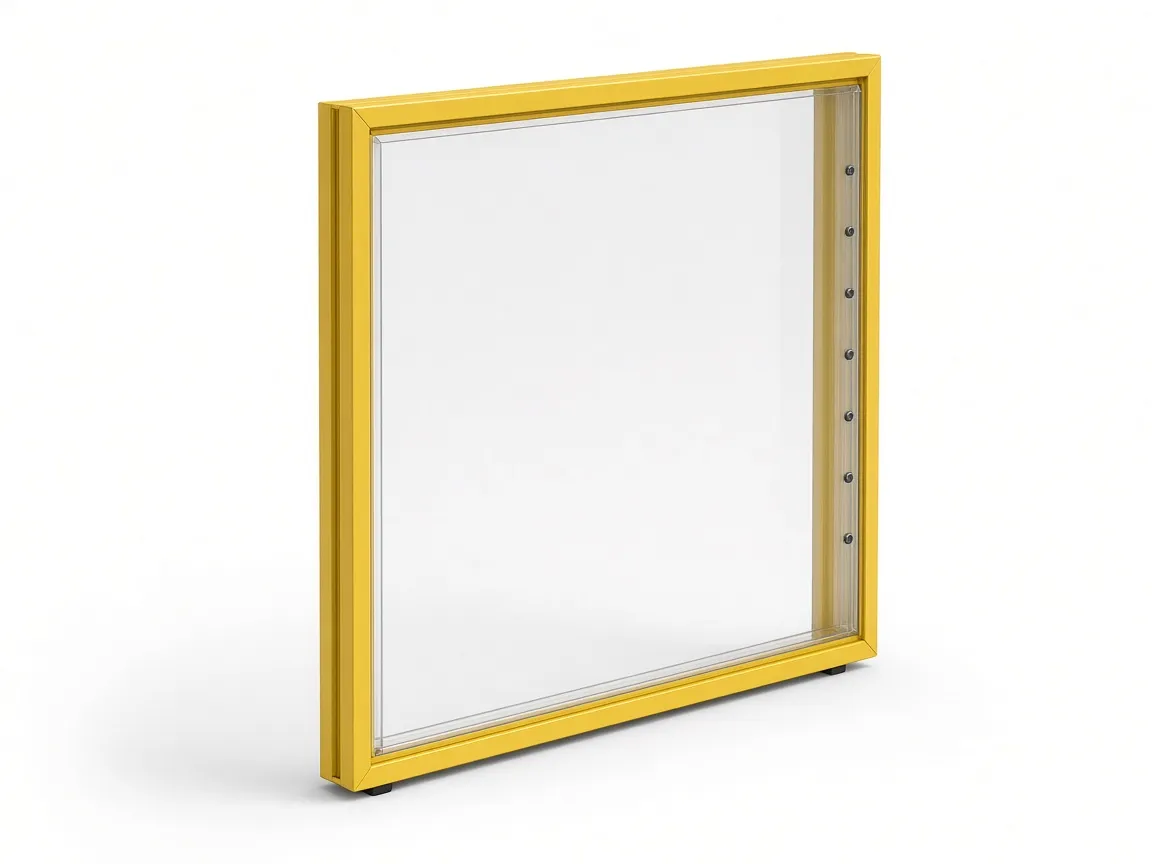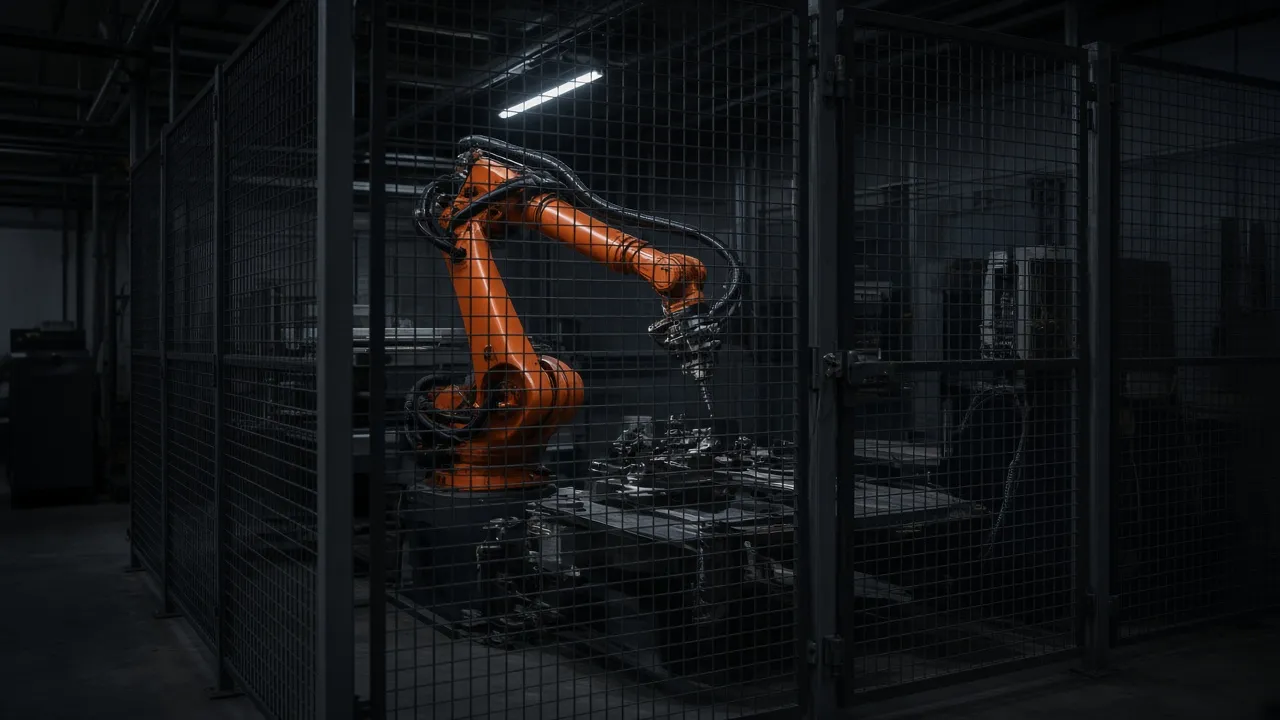
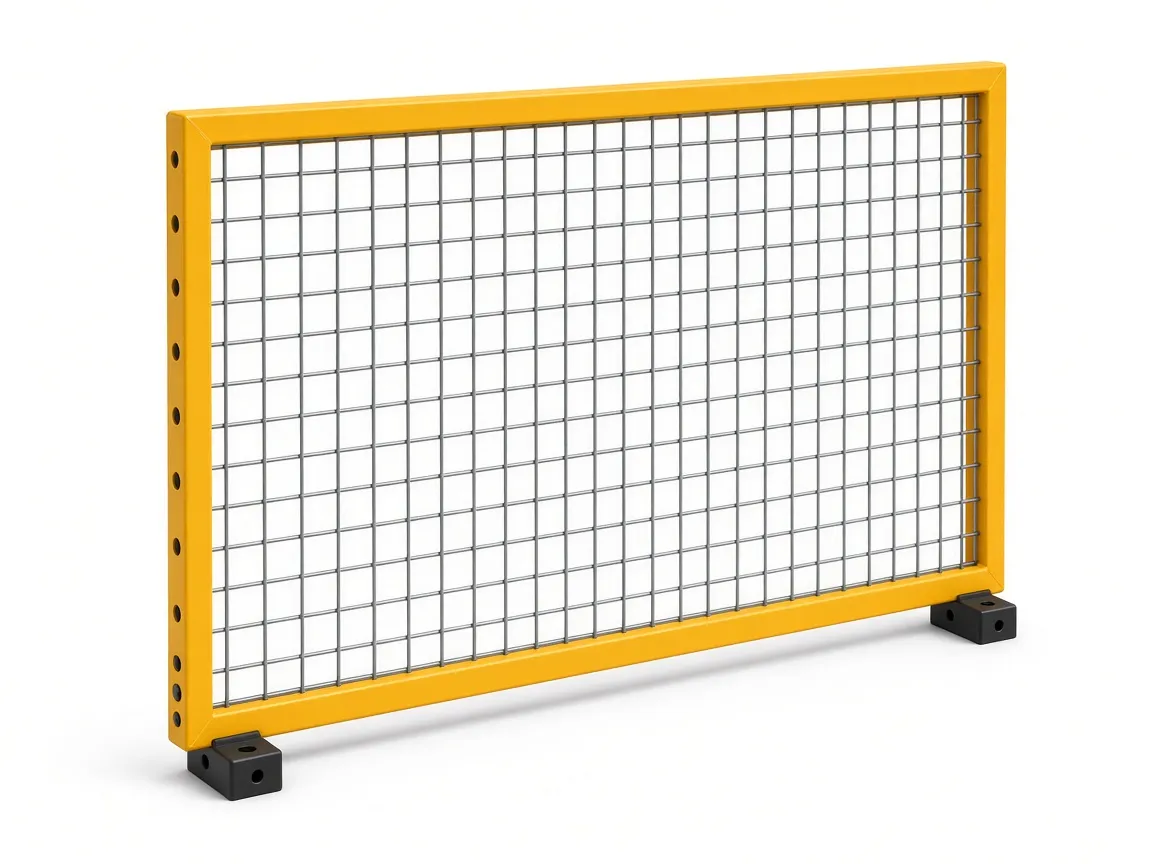
For most perimeters, wire mesh machine guarding is the default: strong, light, see-through and economical. Polycarbonate is the better choice where chips, coolant or small parts must be contained or where the guard stands very close to the hazard. Sheet metal fits welding, spatter and noise. Most cells end up mixing all three, which is easy when every panel type uses the same posts.
Quick comparison
| Wire mesh | Polycarbonate | Sheet metal | |
|---|---|---|---|
| Visibility | Very good | Excellent | None |
| Contains chips, coolant, small parts | No | Yes | Yes |
| Blocks welding spatter and arc light | No | Partly (needs a suitable grade or filter) | Yes |
| Reach-through openings | Yes, sets the minimum distance | None | None |
| Airflow and light | Open | Closed | Closed |
| Relative cost | Lowest | Highest | Middle |
| Typical use | Robot cells, palletizing, conveyors, general perimeters | Machining, assembly, viewing points | Welding cells, noisy or splash-prone areas |
Wire mesh: the default perimeter guard
Wire mesh panels keep people out while leaving the process visible and the air moving. They are light enough to handle without lifting equipment and stiff enough to withstand someone falling against them or a part being thrown. Genmacs D Series panels use a 20 × 100 mm mesh, and the panels have passed the EN ISO 14120 impact test with a 1,950 J pendulum.
The trade-off is the opening. ISO 13857 requires a minimum distance between any opening and the hazard behind it, based on the opening's size and shape. That distance is easy to achieve on a perimeter fence a few feet from the robot, and harder on a guard that sits right against a machine. Our article on ISO 13857 safety distances explains the check.
Polycarbonate: containment and visibility
Polycarbonate panels give a clear view with no openings at all, so they can stand close to the hazard. They also contain chips, coolant mist and small parts that mesh would let through. That makes them a natural fit around machining, deburring, part handling and inspection stations, and as viewing windows in an otherwise solid enclosure.
- Check chemical compatibility: some coolants and cleaners degrade polycarbonate over time.
- For welding, standard clear polycarbonate does not filter arc light; use sheet metal or a suitable welding screen.
- Plan for cleaning: a dirty panel loses the visibility you paid for.
See PC Series polycarbonate panels.
Sheet metal: welding, spatter and noise
Solid sheet metal panels stop spatter, sparks and arc light, damp noise, contain debris and hide equipment from view. They are the usual choice for the sides of welding cells, behind grinding and cutting processes, and anywhere the guard must also act as a screen. The cost is visibility: plan windows, cameras or mesh sections where operators need to see inside.
How to choose, step by step
- Is anything besides people leaving the hazard zone? Chips, coolant, parts or spatter point to polycarbonate or sheet metal on that side.
- How close is the guard to the hazard? If the distance is too short for the mesh opening under ISO 13857, use a solid panel or move the fence.
- Do operators need to see the process? Prefer mesh or polycarbonate.
- Is there welding? Sheet metal around the arc; mesh elsewhere.
- Budget and future changes: mesh is the economical default; a modular system lets you swap individual panels later.
Mixing materials in one fence
Few real cells use one material. A robotic welding cell might use sheet metal behind the torch, mesh on the remaining sides and a polycarbonate window at the operator station. In a modular system all three use the same posts, fixings and safety gates, so mixing costs nothing extra in design or installation. Panel widths from 4 in to 59 in (100 to 1,500 mm) let the perimeter close exactly without cutting.
For the full design process, read our safety fence machine guarding guide or the article on robot cell safety fencing.
Get a panel-by-panel layout
Send ZYD Technology your layout or basic dimensions, mark where chips, spatter or parts can leave the cell, and our engineers will propose the right panel for every side. Request a quote.