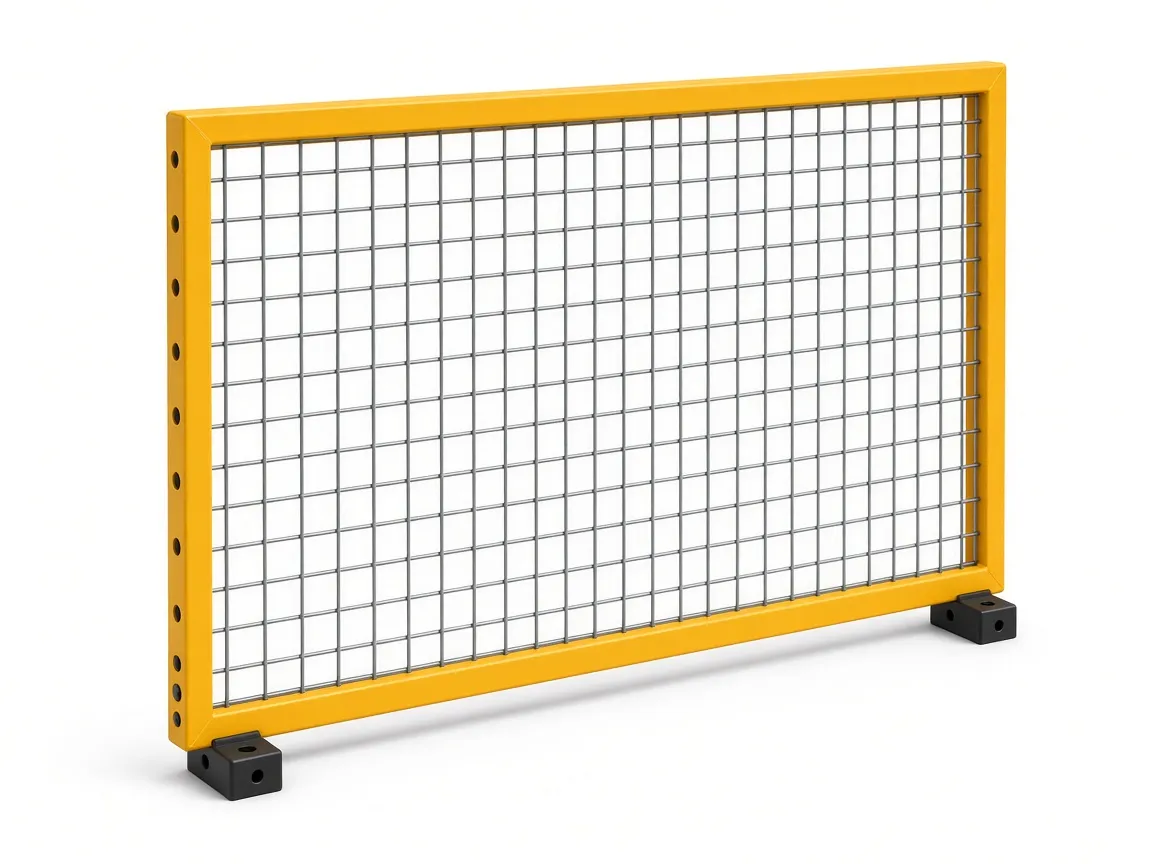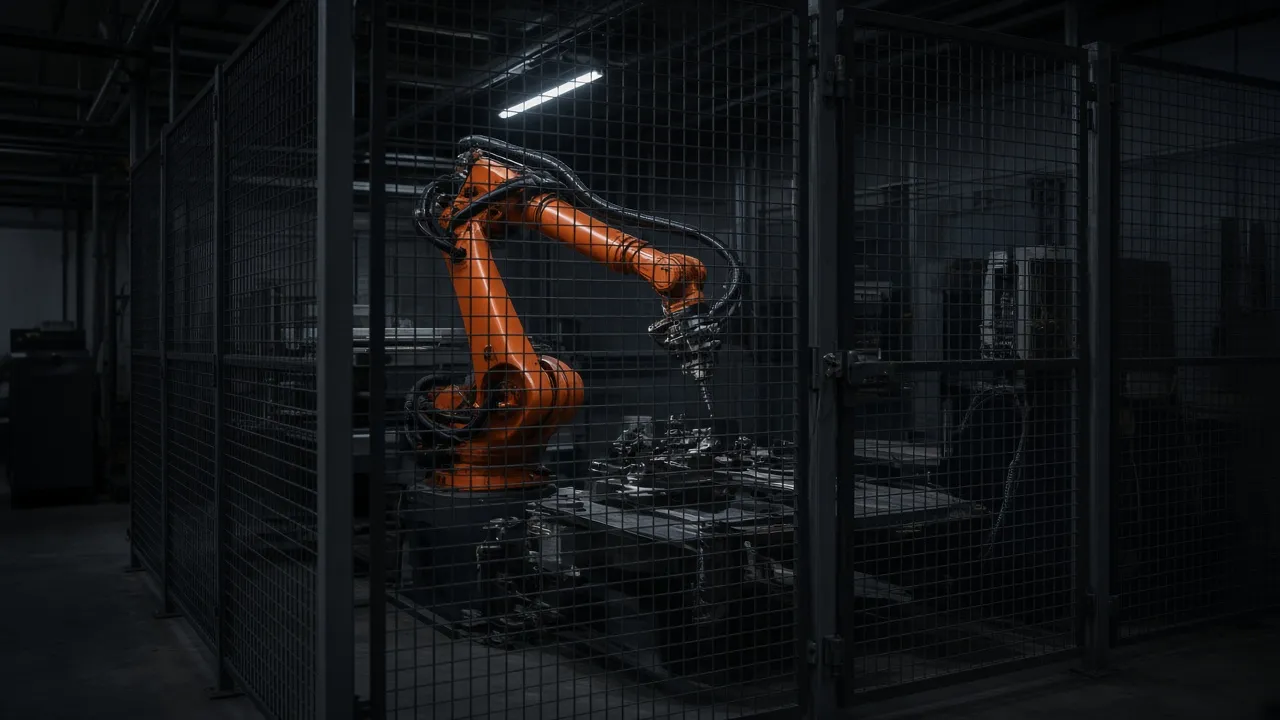
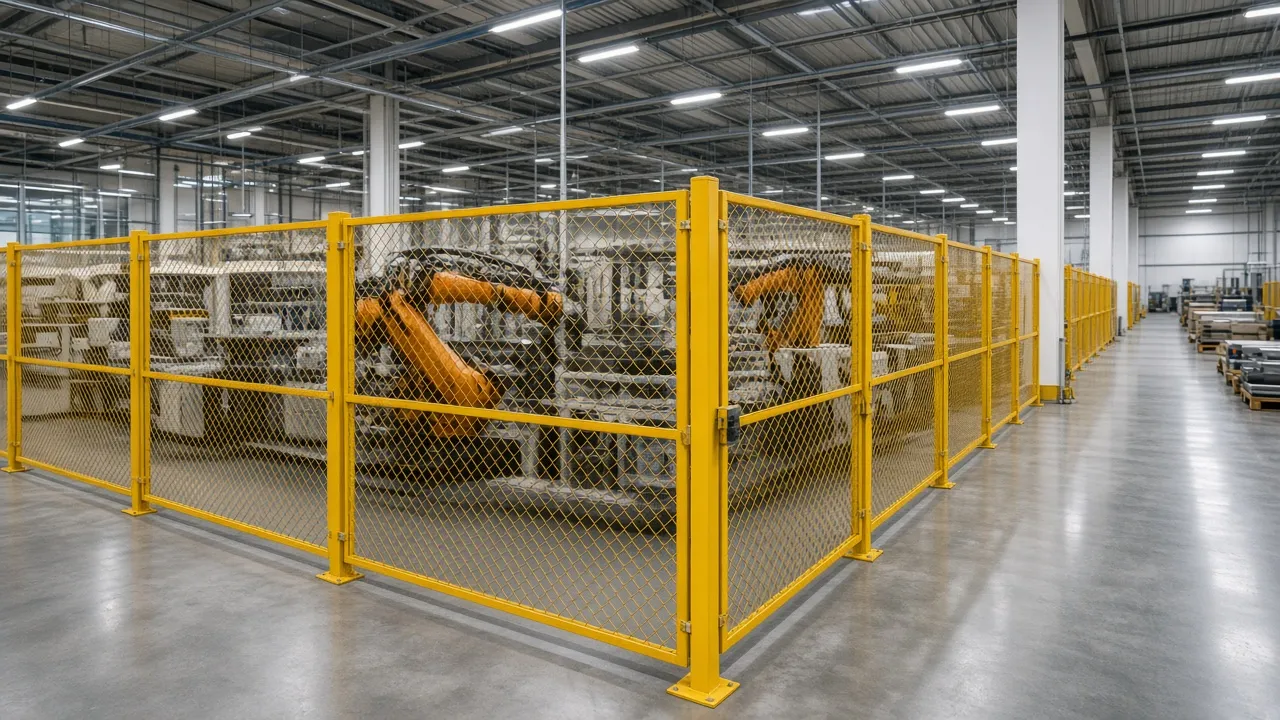
Safety fence machine guarding is a fixed perimeter of mesh, polycarbonate or sheet metal panels with interlocked gates that keeps people out of a machine's hazard zone. In the U.S., OSHA 29 CFR 1910.212 requires that the danger zone be guarded, while ANSI B11.19, ANSI/A3 R15.06 and ISO 13857 tell you how high the fence must be and how far from the hazard it must stand.
This guide walks through what a compliant perimeter guard looks like, the rules behind it, and the decisions that matter when you lay one out: height, distance, openings, panels and access points.
What safety fence machine guarding is (and isn't)
A safety fence is a barrier guard: a physical structure that separates people from moving parts, robots, conveyors and other hazards. Because it works without sensors or anyone's attention, it sits high in the hierarchy of safeguarding and is the default choice wherever nobody needs to be inside the hazard zone while the machine runs.
It is not a replacement for every other safeguard. Points where material must pass through (an infeed, a pallet exit, an operator load station) usually combine the fence with light curtains, tunnels or interlocked doors. Maintenance work inside the cell still needs lockout/tagout under OSHA 29 CFR 1910.147.
Which U.S. rules apply to perimeter guarding
OSHA sets the obligation; consensus standards describe how to meet it.
| Document | What it covers for a safety fence |
|---|---|
| OSHA 29 CFR 1910.212 | General machine guarding: guard the point of operation, nip points and rotating parts; guards must be secured and must not create a hazard themselves. |
| ANSI B11.0 and ANSI B11.19 | Risk assessment for machinery and the performance requirements for guards and safeguarding devices. |
| ANSI/A3 R15.06 | Industrial robot and robot system safety, the U.S. adoption of ISO 10218-1 and -2, including perimeter safeguarding of robot cells. |
| ISO 13857 | Safety distances: how high a barrier must be and how far from the hazard, and how big its openings may be. |
| ISO 14120 and ISO 14119 | Design of fixed and movable guards, and interlocking devices for gates. |
OSHA does not certify fences or approve products. During an inspection, consensus standards are used as evidence of what a recognized, feasible solution looks like, so designing to them is the practical way to show the hazard is controlled. Our guide to OSHA machine guarding requirements covers 1910.212 clause by clause.
How high and how far: sizing the perimeter
Fence height and position are one decision, not two. A lower fence must stand farther from the hazard so nobody can reach over it; a taller fence can stand closer. ISO 13857 gives tables that link three values: the height of the hazard, the height of the barrier and the horizontal distance between them.
- Reaching over: for a given hazard height, the tables give the minimum horizontal distance for each fence height. Structures below 39 in (1,000 mm) are not considered to restrict body movement at all.
- Reaching through: every opening (mesh, gaps between panels, the gap under the fence) needs a minimum distance to the hazard that depends on its size and shape.
- Reaching under: keep the bottom gap small enough that nobody can crawl or reach under, and treat it like any other opening in your distance check.
In practice, a perimeter of about 7 ft 2 in (2,200 mm) covers most robot cells and automated lines, because it allows the fence to stand reasonably close to the hazard. Our machine safety overview shows how heights and mesh openings are selected, and the article on ISO 13857 safety distances works through the method step by step.
Choosing panels: mesh, polycarbonate or sheet metal
Panel material follows from what the fence must stop besides people.
| Panel type | Best for | Watch out for |
|---|---|---|
| Wire mesh | Robot cells, palletizing, conveyors, general perimeters; good visibility and airflow | Opening size sets the minimum distance to the hazard |
| Polycarbonate | Machining, chips and coolant, small parts, areas that need full visibility | Check chemical compatibility and impact rating for the application |
| Sheet metal | Welding cells, spatter, noise, hiding equipment from view | No visibility into the cell; plan camera or window positions |
Most real cells mix materials: mesh on most sides, sheet metal behind the welding torch, polycarbonate where an operator watches the process. A modular system makes that easy because every panel type uses the same posts and fixings. See the D Series, SM Series and PC Series panels, or read our comparison of mesh, polycarbonate and sheet metal guards.
Gates and access points
Every door in a fence is a planned weak point, so treat it carefully:
- Interlock every gate used during normal operation so the hazard stops before anyone reaches it. Select the device and its fitting to resist defeat (ISO 14119).
- Use guard locking when the machine takes longer to stop than a person needs to reach the hazard after opening the gate.
- Fit an escape release on the inside of walk-in cells so nobody can be trapped.
- Pick the gate type for the space: swing gates are simplest, sliding gates save floor space, double gates open wide for forklifts and maintenance.
The safety gate range and integrated handle sets cover these cases; our article on safety gates for machine guarding compares the types.
Layout checklist before you order
- Complete a documented risk assessment (ANSI B11.0 or ISO 12100) and list every hazard the fence must cover.
- Mark the hazard zone, including the robot's maximum reach or the machine's full motion envelope, not just its normal path.
- Choose fence height and position together using ISO 13857, then check every opening, gap and the bottom clearance.
- Place gates where people actually need access, and plan material entry and exit points with the right protective devices.
- Check clearances for maintenance, forklift traffic and future changes to the line.
- Anchor posts to the floor so the fence cannot be moved, and use fixings that need a tool to remove.
- Verify the installed fence against the layout and keep the records with your risk assessment.
Modular fencing versus custom fabrication
A welded, custom fence can fit an odd space, but every later change means cutting and welding. A modular system uses standard panels in many widths, so a perimeter closes without site fabrication and can be extended or moved when the line changes. Genmacs panels come in widths from 4 in to 59 in (100 to 1,500 mm) and heights from 39 in to 89 in (1,000 to 2,250 mm), and have passed the EN ISO 14120 impact test with a 1,950 J pendulum.
Next steps
Good safety fence machine guarding starts with the layout. Send ZYD Technology your machine layout, CAD file or basic dimensions and our engineers will return a guarding layout with panel, gate and access recommendations before you order. Request a quote or read more about our engineering support.