
Safety gates
Safety gates for machine guarding fences
Seven gate types, from operator doors to forklift openings, built from the same panels as the fence and ready for safety door switches.
Gate types
Seven gate types for every kind of access.
Choose by the opening you need and the space in front of the fence. Every gate matches the fence around it and accepts safety door switches.
-
Single Swing Gate
800–1200 mmGEN-SFG-1 · Maintenance and operator access for machine intervention.
-
Double Swing Gate
2 × 800–1200 mmGEN-SFG-2 · Wide access for pallet loading, mold changes and parts handling.
-
Rail-Mounted Sliding Gate
500–1500 mmGEN-SFG-3 · For small loading zones and feeding points. Runs on an upper rail.
-
Wheel-Mounted Sliding Gate
500–6000 mmGEN-SFG-3-W · No floor rail and no connection on the gate, so forklifts pass freely.
-
Telescopic Sliding Gate
500–2400 mmGEN-SFG-4 · Nested panels for sites without room behind a standard sliding gate.
-
Folding Gate
1000–4000 mmGEN-SFG-5 · Wings fold once or twice for large loading and unloading areas.
-
Ergonomic Sliding Gate
1000–4000 mmSliding access designed for frequent, comfortable operation.
Interlocks and access
A gate is a planned access point.
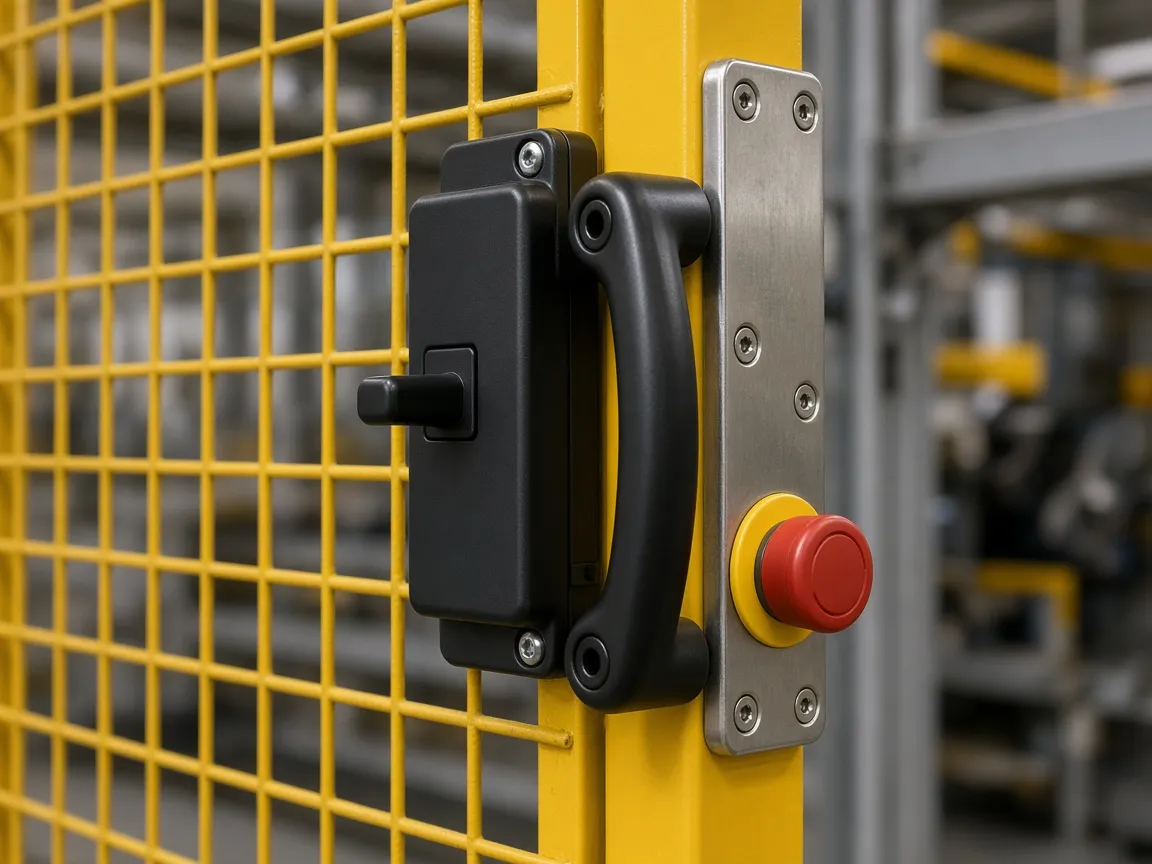
Every gate used during normal operation should stop the hazard before a person can reach it. The handle set carries the controls and works with interlock switches with or without guard locking.
- Interlocking Opening the gate stops the hazard (ISO 14119).
- Guard locking Keeps the gate closed until the machine has stopped.
- Escape release Opens from inside without a key or tool.
- Lockout / tagout Supports personal locks for maintenance.
Matching handle sets for every gate.
The Genmacs safety gate handle set mounts on either hand and combines the door handle, controls and escape release in one assembly.
FAQ
Frequently asked questions
Which gate type should I choose?
Swing gates are the simplest where there is room for the door to open. Sliding gates save floor space along walkways and conveyors. Double, folding and wheel-mounted sliding gates give wide openings for forklifts, pallets and tool changes.
Does every safety gate need an interlock?
Any gate people open to enter the hazard zone during normal operation should be interlocked so the hazard stops before they can reach it. Panels opened only for occasional maintenance can be fixed guards that need a tool to remove, combined with lockout.
When is guard locking needed?
When the machine takes longer to stop than a person needs to open the gate and reach the hazard. Guard locking keeps the gate closed until the hazard has stopped.
Can a wheel-mounted sliding gate be used with forklifts?
Yes. It needs no floor rail and has no connection on the gate, so forklifts can pass freely through the opening.
Plan your access points.
Tell us how people and material move around the machine; we will propose gate types and positions.