Industrial safety fencing is a modular perimeter that separates people from machine hazards. To specify it correctly, choose the panel type, gate type, height, width, and access points based on the hazard, then send a dimensioned layout or CAD file so the guarding can be designed around the real machine footprint.
What industrial safety fencing is and what it must do
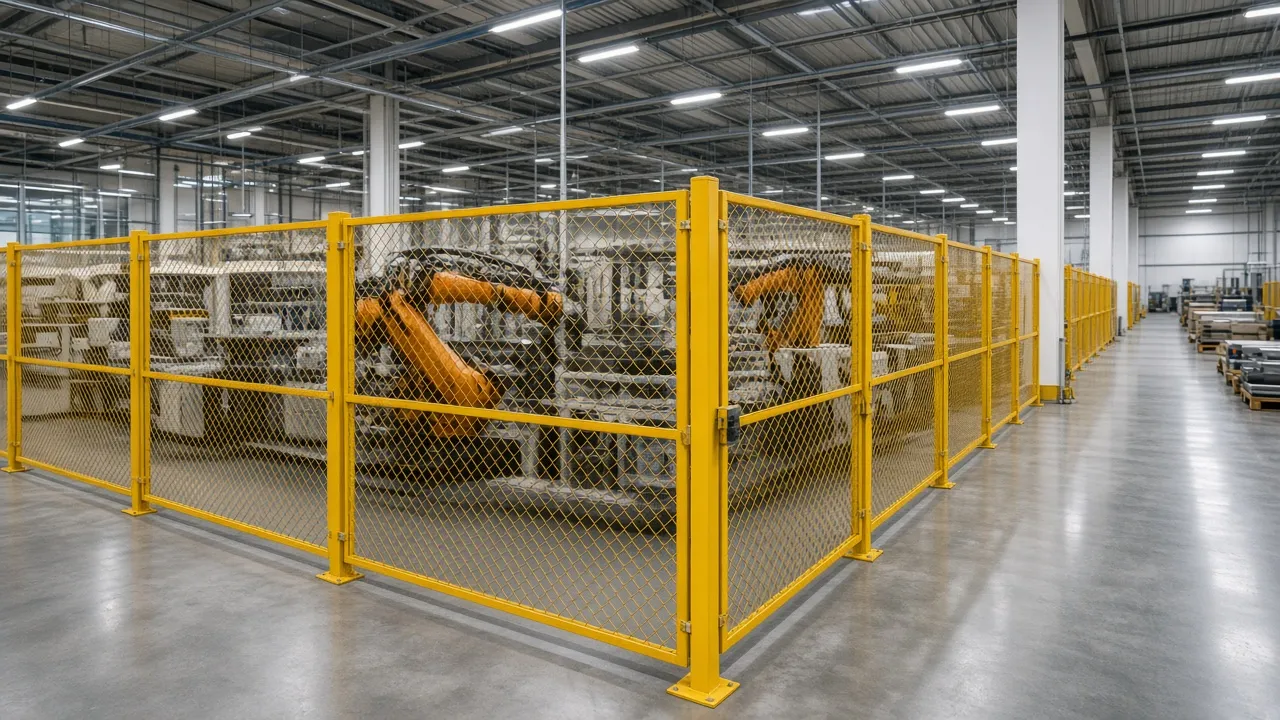
In plant language, fencing, guarding, and perimeter protection often mean the same thing: a modular barrier system that prevents access to dangerous motion, ejected parts, pinch points, and robot reach. The right design depends on the application, the risk, and how people actually move around the cell.
A documented risk assessment by a qualified person should drive the final guarding decisions. The exact layout, panel material, gate style, and interlock strategy should reflect the hazards present and the current edition of the applicable standards.
Start with the application, not the panel catalog
Before you pick a product line, define what the perimeter must protect against. The same fence concept can work very differently in a robot cell, a welding enclosure, a palletizing line, or a CNC tending cell.
Match the fencing to the process
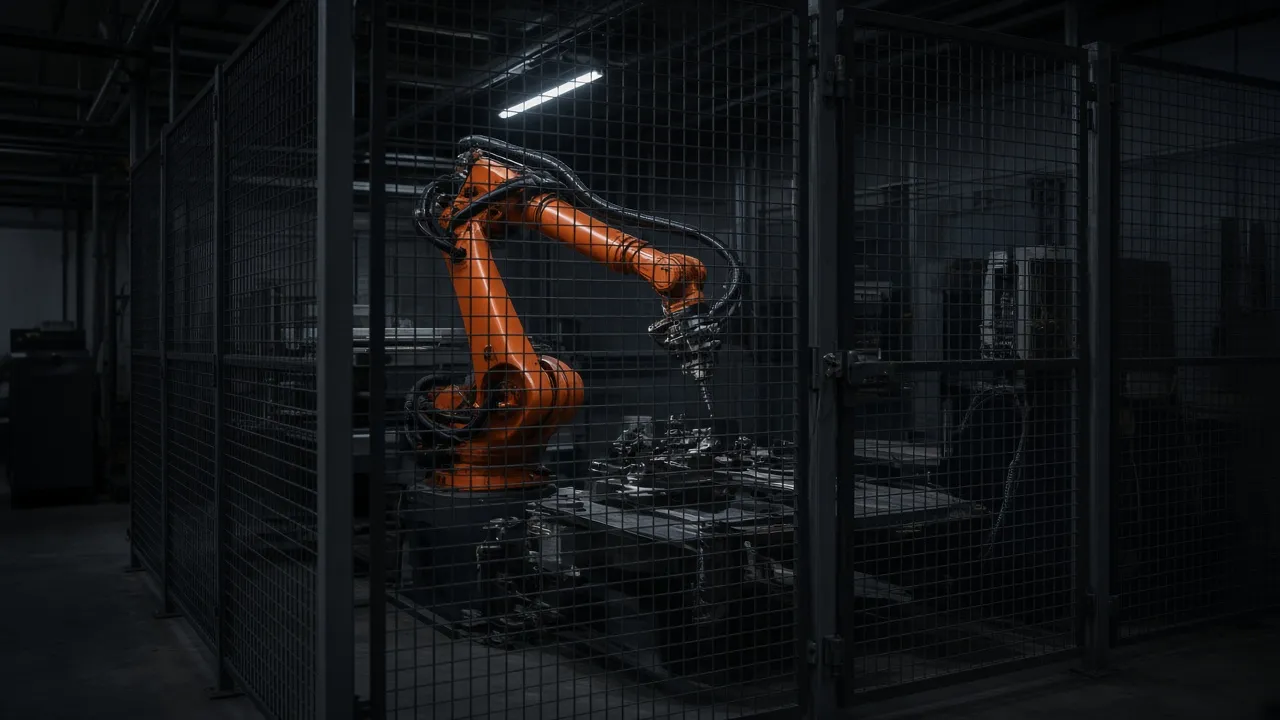
- Robot cells: Need protected openings, controlled access, and clear visibility for setup and maintenance.
- Palletizing and depalletizing: Need tall perimeters, wide access paths, and gates that support pallet flow and forklift traffic.
- Welding: Often need containment for flash, spatter, and smoke, which can point toward solid panel sections.
- Conveyors and transfer points: Need long runs of guarding with carefully located access points at loading, unloading, and maintenance locations.
- CNC machine tools and machine tending: Need containment for chips and coolant while still allowing the operator to inspect the process.
- Material handling and warehouse automation: Need perimeter protection around AS/RS, shuttles, and transfer zones with wide service access where required.
Choose panel type based on the hazard
Panel selection is a trade-off, not a style choice.
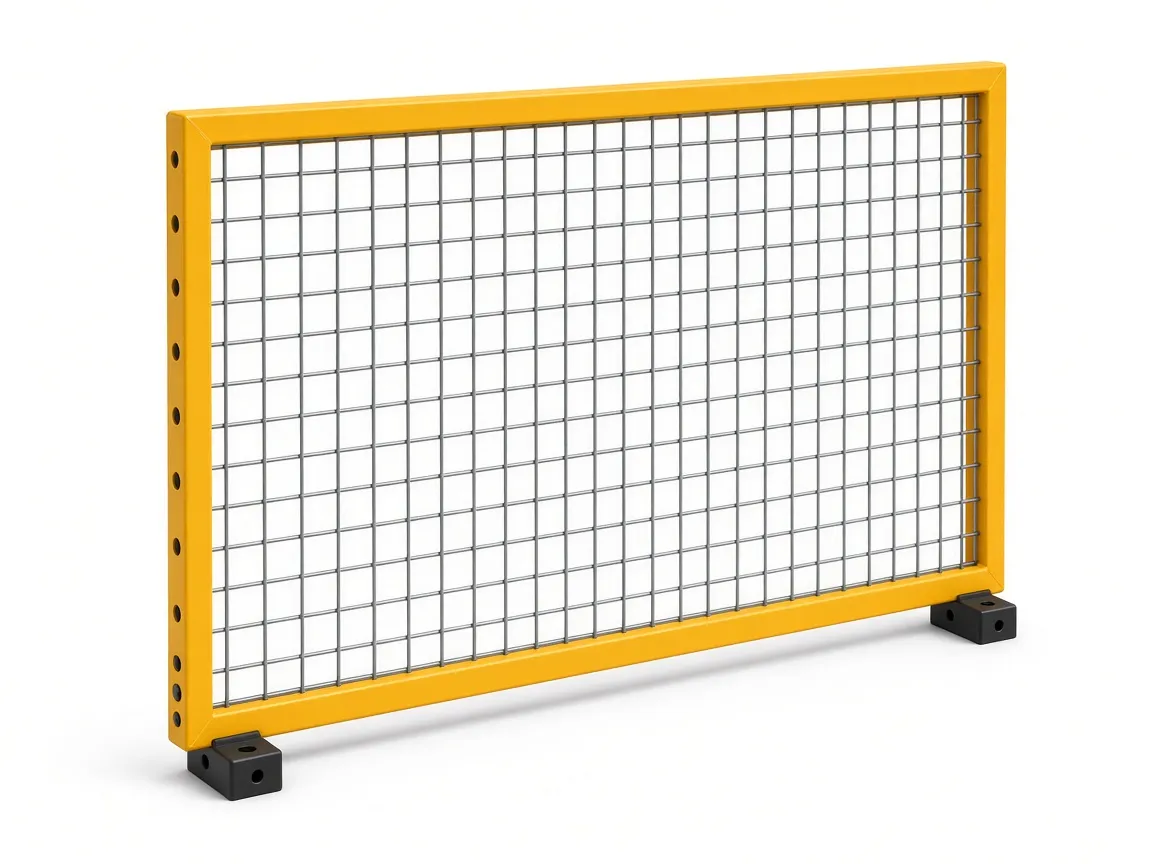
- Wire mesh: Best for general machine perimeters where visibility and airflow matter most.
- Sheet metal: Best where you need spatter containment, privacy, splash protection, or noise reduction.
- Polycarbonate: Best where you need clear visibility and impact-resistant containment for chips, coolant, or small parts.
If you want a quick product comparison, review Wire Mesh Panels (D Series), Sheet Metal Panels (SM Series), and Polycarbonate Panels (PC Series). The right choice depends on what the machine throws, sprays, or exposes.
| Panel type | Best use | Main benefit | Main trade-off |
|---|---|---|---|
| Wire mesh | General machine guarding, robot cells, conveyors | Visibility and airflow | Limited containment of chips, coolant, or spatter |
| Sheet metal | Welding cells, splash zones, privacy barriers | Containment and shielding | Blocks visibility and can feel more enclosed |
| Polycarbonate | CNC tending, chip containment, coolant spray | Visibility plus containment | Usually more application-specific than mesh |
How to specify panel dimensions
Modular widths should follow the actual layout so the perimeter can be built with standard pieces instead of field cutting. Where the layout is planned around standard modules, the enclosure can close without cutting or welding on site. That saves time, reduces installation risk, and makes future changes easier.
For Genmacs modular guarding, panel widths are available from 3 15/16 in to 4 ft 11 in (100 to 1,500 mm), and heights are available from 3 ft 3 3/8 in to 7 ft 4 1/2 in (1,000 to 2,250 mm). The standard height is 7 ft 2 1/2 in (2,200 mm), which is a practical starting point for many machine perimeters.
Where standard dimensions help the buyer
Standard sizes reduce engineering time, simplify ordering, and make installation cleaner. They also make it easier to align posts, doors, and corners around conveyors, cable trays, columns, and equipment frames.
Custom sizing is still useful when a building column, a trench cover, an overhead obstruction, or a line of existing equipment forces a local adjustment. The key is to keep the number of custom pieces as low as possible.
What to note on the layout before you request a quote
- Overall footprint dimensions.
- Panel height target for each run.
- Any low ceilings, cable trays, ducts, or crane clearances.
- Columns, conduit, trench covers, and floor conditions.
- Locations where an access opening must be preserved.
- Any future expansion area that should be left available.
Gate selection: match access method to the task
Gate selection should start with the way people and material actually enter the perimeter. If the gate is too narrow, swings the wrong way, or lands in the wrong spot, the entire guarding layout becomes harder to use and harder to maintain.
Common gate types and where they fit
- Single swing gates: A good fit for normal operator entry and routine access.
- Double swing gates: Useful when you need a wider clear opening for carts, tools, or larger components.
- Sliding gates: A practical choice when swing clearance is limited by aisles, machines, or adjacent fencing.
- Folding or telescoping gates: Useful where floor space is tight and a traditional swing arc will not work.
If you are comparing door styles and hardware, see Safety Gates and the Safety Gate Handle Set for interlocked access, reset, escape release, and LOTO-related functions where appropriate.
What to specify for each gate
- Clear opening width.
- Whether the gate is for daily operator access or maintenance-only access.
- Swing direction or slide direction.
- Whether the gate must be interlocked.
- Whether reset, escape release, or LOTO capability is needed.
- Any wheel carts, pallets, or service tools that must pass through the opening.
For robot applications, gate placement and protected openings are especially important. Review Robot Cell Guarding when the perimeter supports industrial robots or robot systems.
What standards influence the specification
Several standards usually inform the guarding design, but they do not replace a risk assessment. The applicable requirements depend on the machine, the hazard, and the control architecture.
- OSHA 29 CFR 1910.212: Sets the baseline expectation for machine guarding in general industry.
- ANSI B11.0 and ANSI B11.19: Commonly used for risk reduction and safeguarding principles in U.S. machine applications.
- ANSI/A3 R15.06 and ISO 10218-1/-2: Apply to industrial robots and robot systems.
- ISO 12100: Addresses risk assessment and risk reduction.
- ISO 14119: Covers interlocking devices associated with guards.
- ISO 14120: Covers the general requirements for the design and construction of guards.
- ISO 13855 and ISO 13857: Address safety distances and reach considerations around guards.
- ISO 13849-1 and NFPA 79: Become important when the guarding system includes safety-related control functions and electrical integration.
Always check the current edition of each standard and confirm the exact requirements for your application. If your cell includes robot motion, wide access points, or interlocked doors, the details matter. For a quick reference on distance calculations used in some safeguarding applications, see the Safety Distance Calculator.
RFQ checklist: the information the supplier needs to quote accurately
The better the input, the better the guarding proposal. A good RFQ should give the supplier enough information to understand the layout, the hazards, and the way people and material move through the area.
- Machine or cell function and the main hazards present.
- Overall perimeter footprint dimensions.
- Layout drawing, CAD file, or dimensioned sketch.
- Entry points, operator paths, and forklift traffic patterns.
- Desired panel type or application goal, such as visibility, chip containment, or spatter protection.
- Target perimeter height for each run.
- Gate locations, clear opening widths, and gate type preferences.
- Whether any gate must be interlocked.
- Floor condition, anchoring constraints, and any slab or trench issues.
- Columns, ductwork, cable trays, or other obstructions.
- Whether the layout needs to leave space for future expansion.
- Whether you want a 2D/3D guarding layout before ordering.
If you already have a layout, send it to Engineering for a review of access points and safety distances. If you are ready to request pricing, use Request a quote.
Worked examples
Example 1: Welding cell
A robotic welding cell usually needs more than a simple mesh perimeter. If spatter and flash are the dominant concerns, sheet metal sections can be placed where the process is most aggressive, while mesh is used where visibility matters and the hazard is lower. The gate should be placed where operators actually load parts and where maintenance can reach the positioner or torch area without creating unnecessary access.
Example 2: CNC tending cell
A CNC tending enclosure often needs visibility, chip containment, and coolant resistance at the same time. Polycarbonate panels are a strong option when the operator needs to watch the cycle while chips and coolant must stay inside the perimeter. The access gate should be sized around tool changes, part handling, and maintenance access rather than guessed from the machine footprint alone.
Example 3: Palletizing line
A palletizing line usually needs a taller perimeter and a wider access strategy than a standard machine guard. The layout should account for pallet movement, forklift traffic, and service access to the robot, conveyor, or transfer point. For applications like this, see Palletizing Guarding and Warehouse & Material Handling Guarding.
Common mistakes buyers make
The most expensive mistakes usually happen before the quote is issued.
- Choosing a panel type before defining the hazard.
- Forgetting to specify clear gate opening width.
- Ignoring maintenance access when placing doors.
- Leaving obstructions, columns, or utilities out of the sketch.
- Using one height everywhere when the line actually has different access needs.
- Skipping the risk assessment and assuming a catalog part solves the problem.
- Failing to confirm how the perimeter fits with the process flow.
How to compare quotes apples-to-apples
When you compare bids, make sure every supplier is quoting the same perimeter line and the same assumptions. Ask each one to confirm panel type, height, width mix, number of gates, gate hardware, anchoring assumptions, and whether the installation can be completed without on-site cutting or welding.
Also ask what engineering support is included. A cheaper quote can become expensive if the layout is incomplete or the hardware does not match the machine access points. If your project spans multiple applications, the safest path is to compare vendors on scope, not just price.
When to involve engineering before ordering
Bring engineering in early if the layout is tight, if there are multiple access points, or if the cell includes conveyors, transfer stations, overhead obstructions, or robot motion. Early review is also important when the guarding must support daily operator access and maintenance access at the same time.
ZYD Technology reviews layouts, CAD files, and basic dimensions, then returns a 2D/3D guarding layout before ordering so you can verify the perimeter before you commit. If you want a practical way to turn a rough concept into a buildable solution, start with the application pages under Solutions and, if helpful, review Projects for examples of modular guarding in real factories.
Conclusion
The fastest way to specify industrial safety fencing is to define the hazard, choose the right panel type, size the gates for actual access needs, and send a dimensioned layout for review before you order. That approach reduces installation problems, helps align the perimeter with the machine, and makes the RFQ easier for everyone to evaluate.
If you are planning a new machine perimeter or replacing an existing guard, send your layout, CAD file, or basic dimensions and request a guarding proposal before fabrication begins.