ANSI B11.19 is the U.S. consensus standard for safeguarding machinery: it sets the performance requirements for guards, interlocks and safeguarding devices once a risk assessment (ANSI B11.0) has shown what needs protecting. For industrial robots, ANSI/A3 R15.06 adopts ISO 10218 and covers how robot cells are safeguarded. OSHA sets the legal duty to guard; these standards describe how to do it in a way inspectors, insurers and customers recognize.
How the U.S. standards fit together
| Document | Role |
|---|---|
| OSHA 29 CFR 1910.212 | The legal requirement: guard machine hazards so no body part is in the danger zone. |
| ANSI B11.0 | Safety of machinery: general requirements and the risk assessment process. |
| ANSI B11.19 | Performance requirements for risk reduction measures: guards, interlocks, safeguarding devices, safety distances. |
| Machine-specific ANSI B11 standards | Standards for particular machine types (for example B11.1 for mechanical power presses) that build on B11.0 and B11.19. |
| ANSI/A3 R15.06 | Industrial robots and robot systems: U.S. adoption of ISO 10218-1 and -2. |
| NFPA 79 | Electrical equipment of industrial machinery, including safety circuits. |
For the OSHA side, see our guide to OSHA machine guarding requirements.
ANSI B11.0: start with the risk assessment
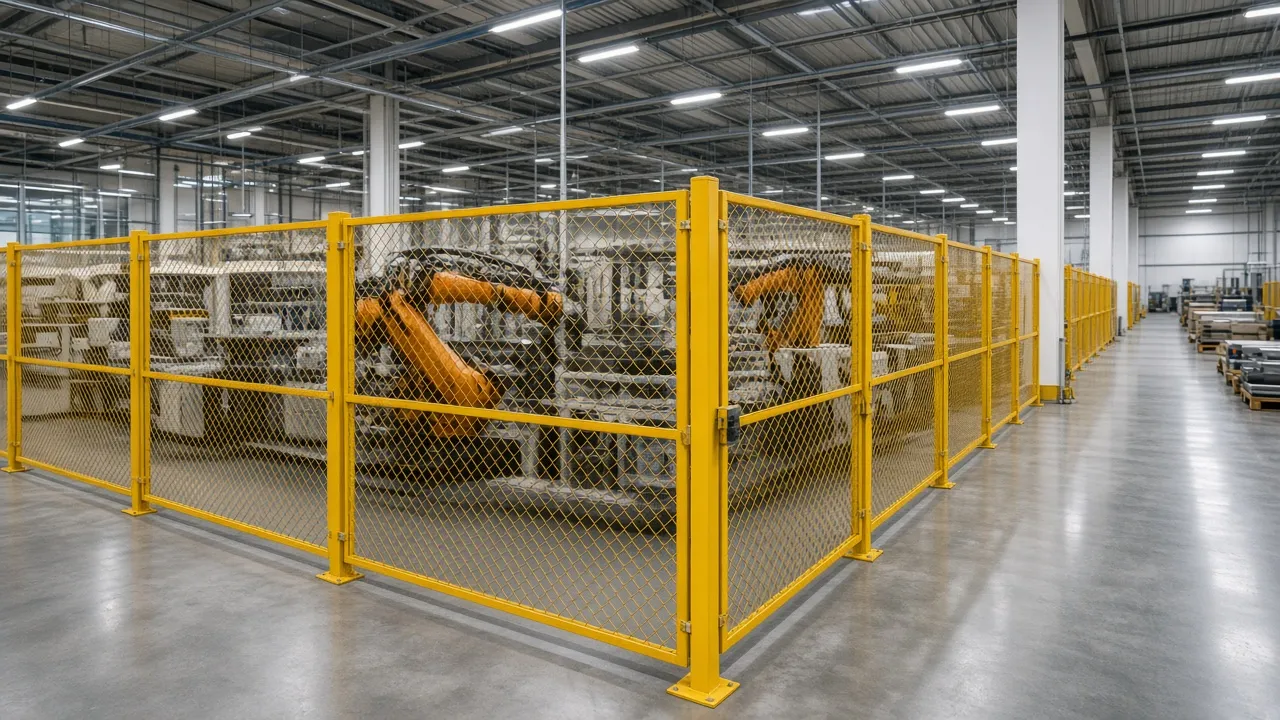
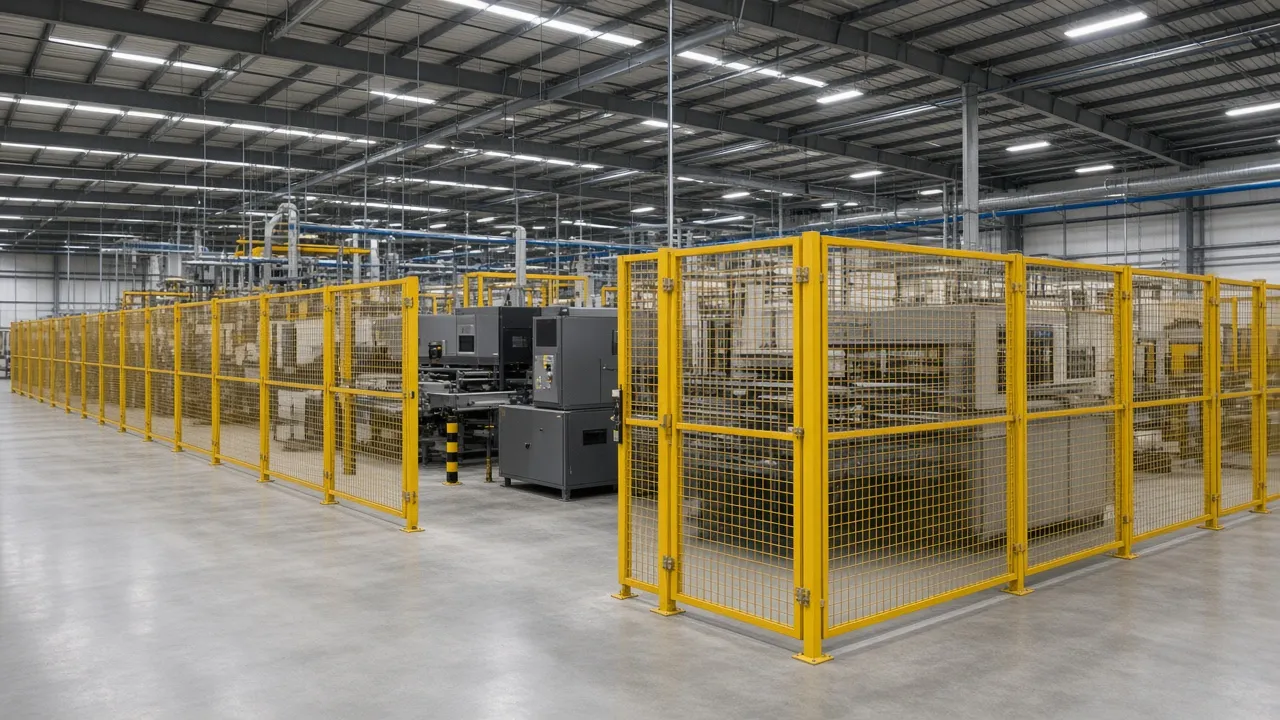
B11.0 describes how to identify tasks and hazards, estimate risk and choose risk reduction measures in order of effectiveness: eliminate or substitute the hazard first, then engineering controls such as guards and safeguarding devices, then awareness means, training and procedures, and finally personal protective equipment. A perimeter fence is an engineering control high in that order, because it does not depend on people's behavior.
ANSI B11.19: performance requirements for safeguarding
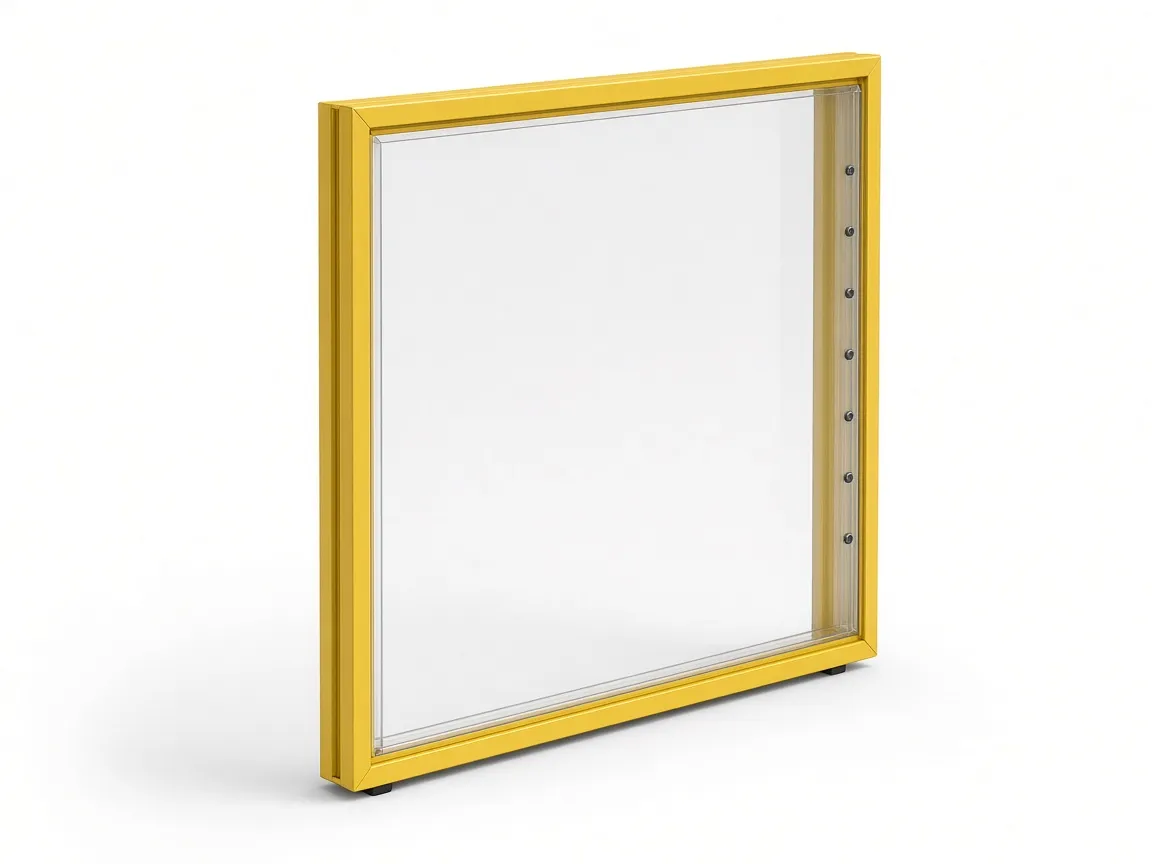
Once a guard or device is chosen, B11.19 sets out what it has to achieve. For fixed and interlocked barrier guards, the practical points are:
- Prevent reaching over, under, around or through the guard to the hazard, using recognized safety distance data.
- Be securely fastened and removable only with a tool, or interlocked if opened during normal work.
- Not create additional hazards such as sharp edges or pinch points.
- For devices such as light curtains: be placed at a safety distance based on the machine's stopping time and a hand speed constant of 63 in/s (1,600 mm/s).
The barrier distance tables in ISO 13857 are widely used alongside B11.19 for perimeter fences; our article on ISO 13857 safety distances shows the method.
ANSI/A3 R15.06: robot cells
R15.06 is the U.S. adoption of ISO 10218-1 (the robot) and ISO 10218-2 (robot systems and integration). The 2025 edition followed the 2025 revision of ISO 10218, which reorganized the requirements and brought collaborative applications into the main documents. For perimeter guarding, the integrator's responsibilities include:
- A risk assessment of the whole robot system, not just the robot.
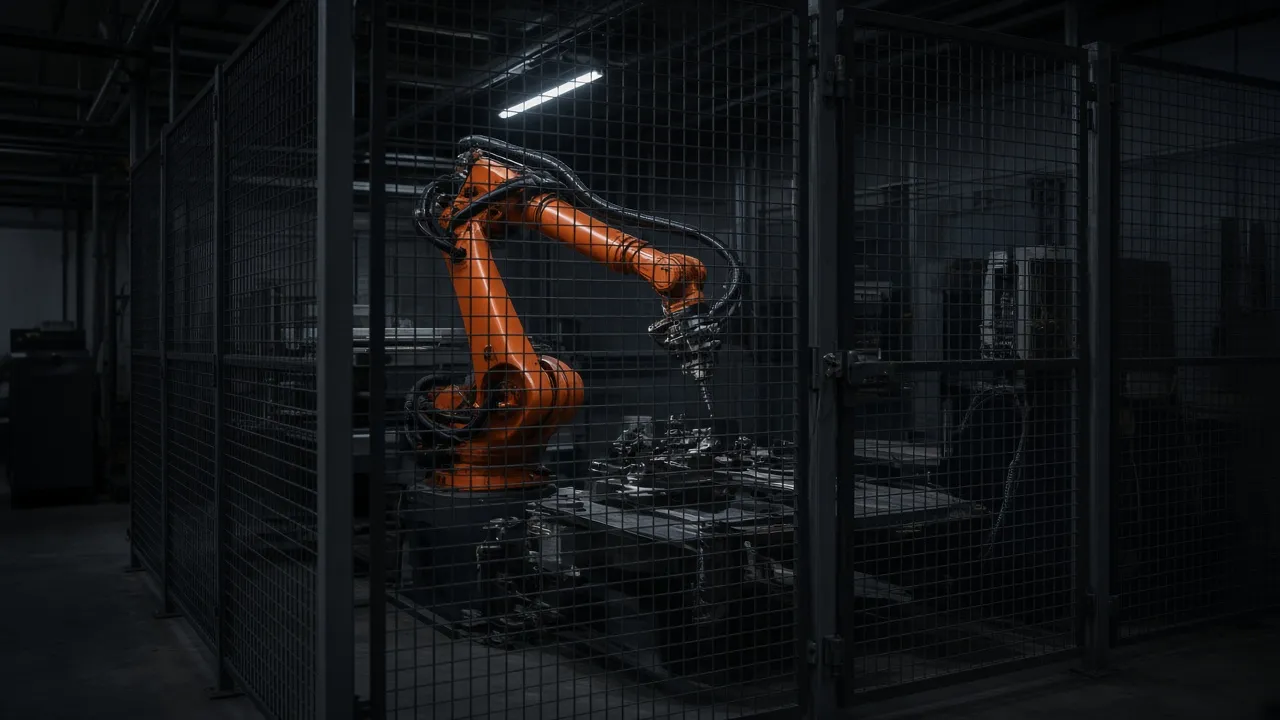
- Safeguarding the space the robot can reach, or a reduced space limited by safety-rated functions.
- Perimeter guards sized with ISO 13857, interlocked access, and protective devices at material openings.
- Validation of every safety function before the cell runs in production.
Our guide to robot cell safety fencing turns these into a layout checklist.
How ANSI and ISO relate
The ANSI B11 series and the ISO machinery standards were developed with each other in mind and are closely aligned: B11.0 parallels ISO 12100, and B11.19 covers ground that ISO 13857, ISO 13855, ISO 14119 and ISO 14120 cover in Europe. R15.06 goes further and adopts ISO 10218 directly. Many U.S. specifications therefore cite both families; what matters is that your design meets the documents your customer or your own safety program names, in their current editions.
What this means for a safety fence
- Document the risk assessment (B11.0 / ISO 12100, or R15.06 for robot systems).
- Size fence height, distance and openings with recognized distance data (B11.19 / ISO 13857).
- Interlock gates and choose guard locking where stopping time requires it (B11.19 / ISO 14119).
- Build safety circuits to the required reliability and wire them to NFPA 79.
- Validate and keep the records.
Read our safety fence machine guarding guide for the complete process.
Work with an engineering partner
ZYD Technology helps U.S. machine builders and integrators lay out perimeter guarding that fits these standards. Send us your layout and our engineering team will propose a fence and gate design.