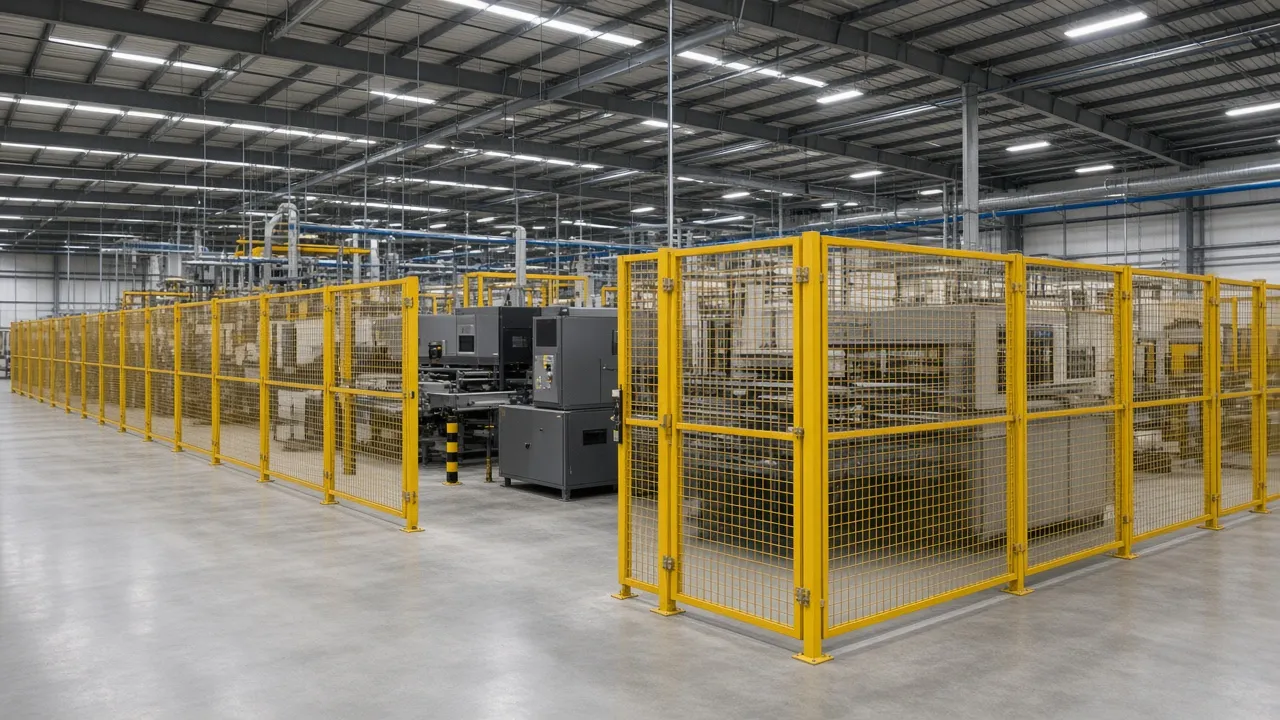
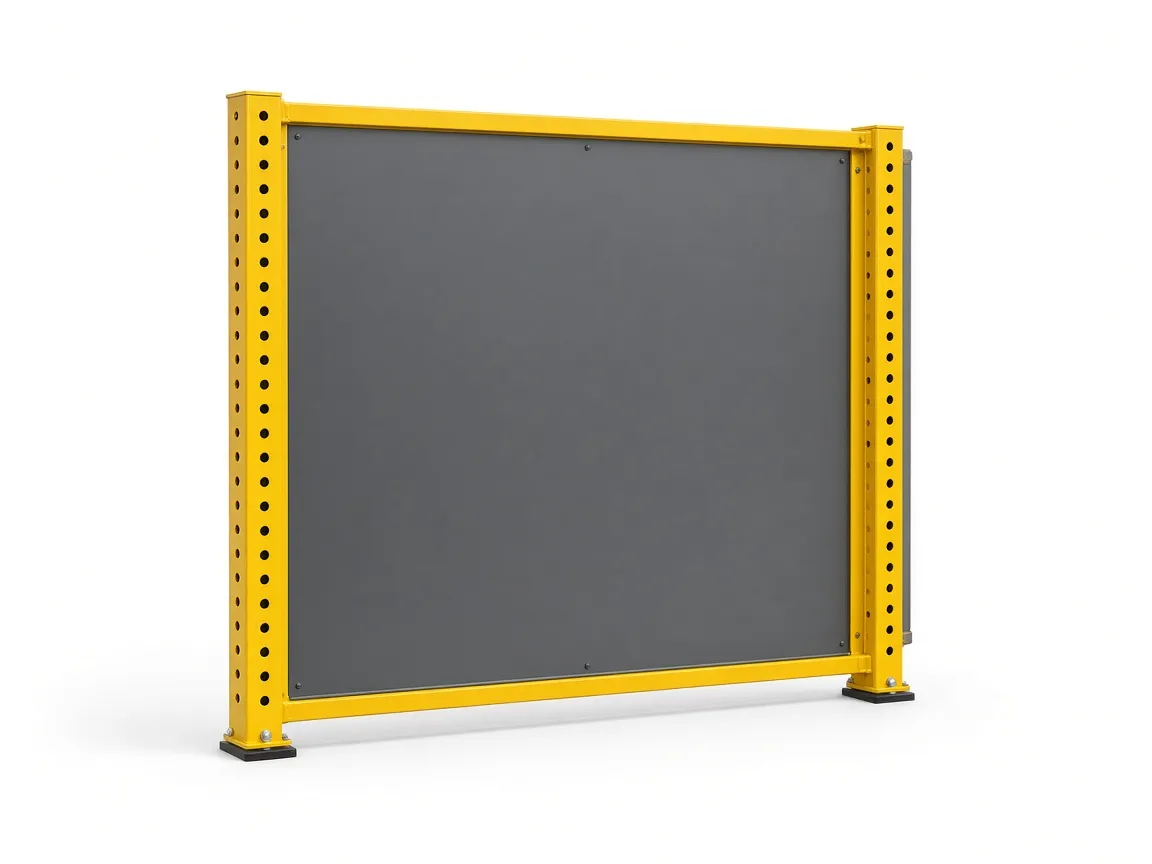
ISO 13857 safety distances tell you how high a fixed guard must be, how far it must stand from the hazard, and how large its openings may be, so that nobody can reach the hazard over, through or under it. The distances depend on three things you can measure on your layout: the height of the hazard, the height of the guard, and the size and shape of every opening.
The three ways a person can reach a hazard
ISO 13857 treats a guard as a barrier and checks each way the body can get past it:
- Reaching up to a hazard above the body when there is no barrier.
- Reaching over the top of a barrier.
- Reaching through or around openings in the barrier: mesh, gaps between panels and the gap under the fence.
A guard is acceptable only when all three checks pass for every hazard behind it.
Reaching over: fence height versus distance
The reach-over table links three values: a, the height of the hazard zone; b, the height of the protective structure; and c, the horizontal distance from the structure to the hazard. For a given hazard height, a taller fence can stand closer, and a lower fence must stand farther away.
- Find the highest point of the hazard behind each side of the fence, including a robot's maximum reach or a machine's full motion.
- Pick the risk level from your risk assessment. ISO 13857 gives separate values for low and high risk; the high-risk values apply where reaching the hazard could cause serious injury.
- Read the minimum horizontal distance for your fence height. If the layout does not allow it, choose a taller fence or move the fence.
Two limits are worth remembering. Structures below about 39 in (1,000 mm) are not counted as restricting body movement at all. And when the hazard itself is high enough above the floor, it cannot be reached by reaching up, so no barrier is needed for that reason alone; the standard gives these heights separately for low and high risk.
This is why most perimeter fences are tall. A fence of around 7 ft 2 in (2,200 mm), the standard height of Genmacs panels, can usually stand close to the hazard and still pass the reach-over check, which saves floor space in crowded plants.
Reaching through: openings and mesh
Every opening needs a minimum distance to the hazard that depends on its size and shape. The tables distinguish slots, squares and round openings, and give larger distances as the opening moves from fingertip size to finger, hand and arm size. Use the opening's governing dimension as the standard defines it, which for a slot is its width.
For a mesh panel, check the mesh opening against the table and keep the panel at least that distance from the hazard behind it. Then check the openings people forget:
- Gaps between panels, between panels and posts, and at corners.
- Gaps around conveyors, cables and pipes that pass through the fence.
- The gap between the floor and the bottom of the fence.
- Gaps around gates when they are closed, including at hinges and latches.
Where a guard has to stand closer to the hazard than its openings allow, switch that section to a solid polycarbonate or sheet metal panel. See our comparison of guard panel materials.
Reaching under the fence
The gap under a fence is an opening like any other. Keep it small enough that nobody can crawl under, and check it against the opening table for the hazard behind it. For robot cells, the 2011 edition of ISO 10218-2 set a maximum bottom gap of about 7 in (180 mm) in addition to the ISO 13857 checks; our article on robot cell safety fencing covers this.
ISO 13857 versus ISO 13855 and ANSI B11.19
ISO 13857 applies to fixed barriers that physically stop a person. Protective devices such as light curtains and area scanners do not stop anyone; they detect a person and stop the machine. Their distance therefore depends on time, and comes from ISO 13855:
S = (K × T) + C, where K is the approach speed (2,000 mm/s, or 1,600 mm/s where the result exceeds 500 mm), T is the total stopping time of the device, control system and machine, and C is an intrusion allowance based on the device's detection capability.
ANSI B11.19 uses the same idea with U.S. units and a hand speed constant of 63 in/s (1,600 mm/s), the same constant OSHA uses for presses in 1910.217. Measure the machine's actual stopping time; never take it from a brochure. Our safety distance calculator applies both formulas.
Worked layout process
- Draw the hazard zone on the layout at its maximum extent.
- Choose a fence height you can install, typically 7 ft 2 in (2,200 mm).
- Read the minimum reach-over distance for each side from ISO 13857 and place the fence line.
- Check the mesh opening and every gap against the reach-through table at the actual distance.
- Check the bottom gap.
- For each opening protected by a light curtain or scanner, calculate the distance with ISO 13855 or ANSI B11.19.
- Document the values with the risk assessment.
For the full picture see our safety fence machine guarding guide and the machine safety overview.
Let us check the distances
ZYD Technology checks heights, distances and openings on every layout before you order. Send a CAD file, a sketch or basic dimensions and our engineers will return a guarding layout. Request a quote.