OSHA machine guarding requirements come mainly from 29 CFR 1910.212: every machine hazard that could injure an operator or anyone nearby (the point of operation, ingoing nip points, rotating parts, flying chips and sparks) must be guarded, and the guard must be secure and must not create a new hazard. OSHA sets this goal but rarely says exactly how to build the guard, so consensus standards fill in the details.
What 29 CFR 1910.212 says
The general requirements for all machines are short, which is why they are applied so widely:
- 1910.212(a)(1), types of guarding: one or more methods of machine guarding shall protect the operator and other employees from hazards such as the point of operation, ingoing nip points, rotating parts, and flying chips and sparks. Barrier guards, two-hand tripping devices and electronic safety devices are named as examples.
- 1910.212(a)(2), general requirements: guards shall be affixed to the machine where possible and secured elsewhere if attachment is not possible. The guard must not offer an accident hazard in itself.
- 1910.212(a)(3), point of operation: the guard must prevent the operator from having any part of the body in the danger zone during the operating cycle.
- 1910.212(a)(5), fan blades: when the periphery of fan blades is less than 7 ft (2.1 m) above the floor or working level, the blades must be guarded, with openings no larger than 1/2 in (12.7 mm).
- 1910.212(b), anchoring: machinery designed for a fixed location must be securely anchored so it cannot walk or move.
Specific machines have their own sections, for example mechanical power presses in 1910.217 and mechanical power-transmission apparatus (belts, pulleys, shafts, gears) in 1910.219. Where a specific section applies, it takes precedence for that hazard.
How inspectors judge a guard
Because 1910.212 is performance-based, the practical test is simple: can any part of a person's body reach the hazard while the machine is running? Inspectors look for:
- Openings large enough for fingers, hands or arms to reach a hazard behind the guard.
- Guards that can be removed without a tool, or that are routinely left open.
- Gaps under, over or around a fence that someone could reach through or climb.
- Interlocks that are bypassed, taped over or easy to defeat.
- Guards that themselves create a hazard: sharp edges, unstable panels, pinch points.
Machine guarding consistently appears on OSHA's list of the most frequently cited standards, and many citations involve guards that existed but were removed, bypassed or never covered the whole hazard.
Where consensus standards come in
OSHA rarely gives dimensions. When it evaluates whether a hazard was recognized and whether a feasible fix existed, including under the General Duty Clause, it often refers to consensus standards. Designing to them is the most defensible way to meet 1910.212:
| Standard | Use it for |
|---|---|
| ANSI B11.0 | Risk assessment for machinery: identify hazards, estimate risk, choose risk reduction measures. |
| ANSI B11.19 | Performance requirements for guards, interlocks and safeguarding devices, including safety distance calculations. |
| ANSI/A3 R15.06 | Robot and robot system safety, including perimeter guarding of robot cells. |
| ISO 13857 | How high, how far and how open a barrier can be. |
| NFPA 79 | Electrical equipment of industrial machinery, including how safety circuits are wired. |
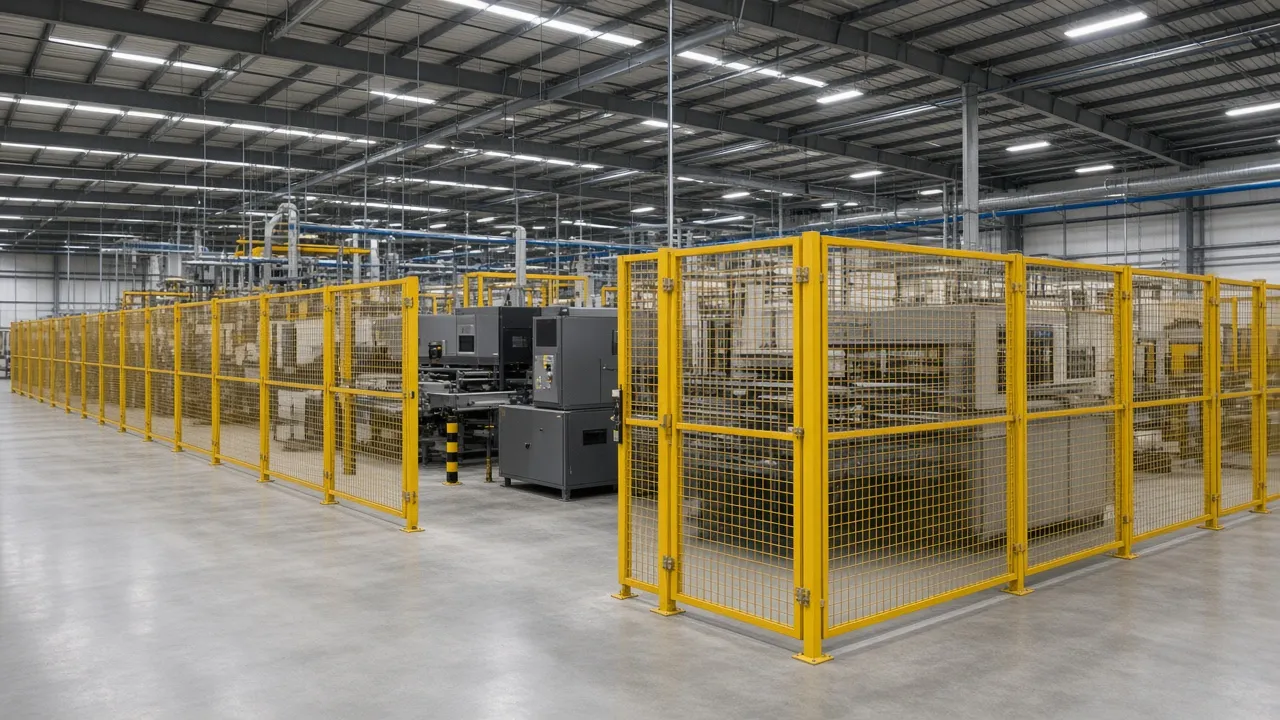
For perimeter fences in particular, see our complete guide to safety fence machine guarding.
Guarding versus lockout/tagout
Guarding and lockout/tagout solve different problems. Guards protect people during normal production. Lockout/tagout (29 CFR 1910.147) protects them during servicing and maintenance, when the guard is opened or removed and someone must enter the hazard zone. A perimeter fence with interlocked gates reduces how often full lockout is needed for routine tasks, but it does not replace a lockout program for maintenance.
Robot cells and automated lines
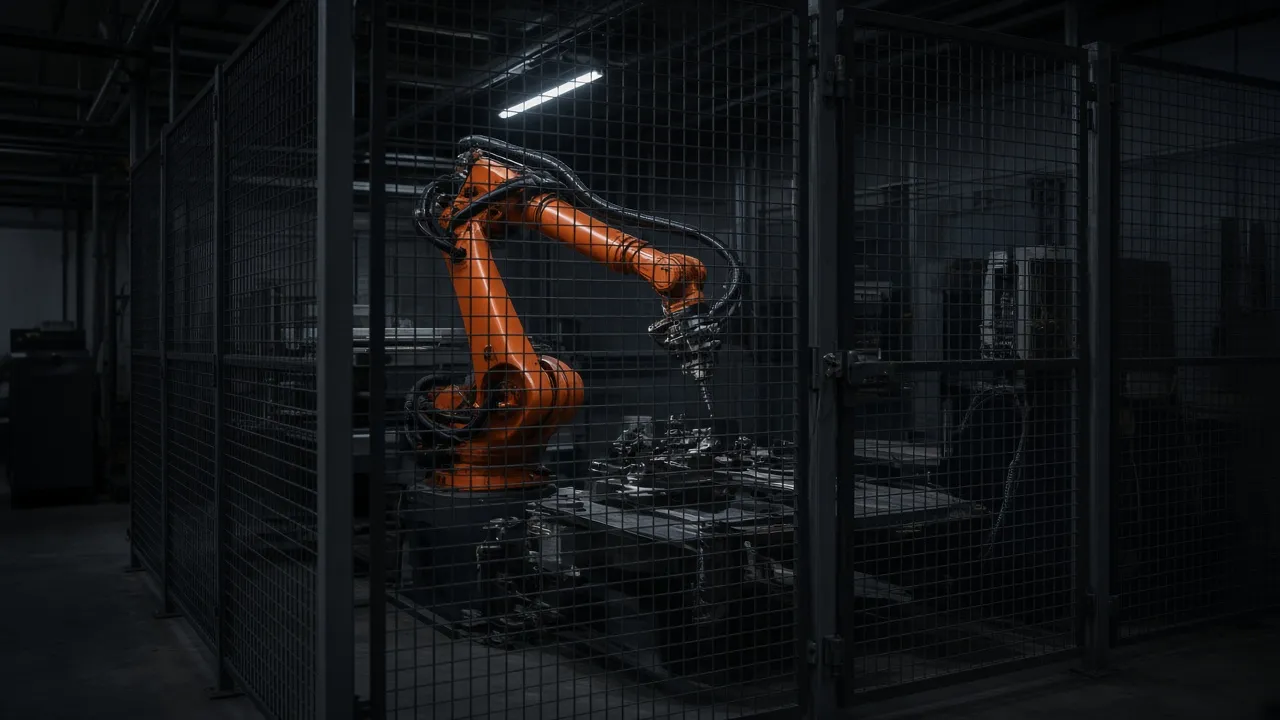
There is no OSHA standard written specifically for industrial robots. Robot cells are covered by the general requirements, including 1910.212 and the General Duty Clause, and OSHA's Technical Manual chapter on industrial robots points to the consensus standard ANSI/A3 R15.06. In practice that means a perimeter guard sized with ISO 13857, interlocked access gates, and protective devices at material entry and exit points. Our robot cell guarding solutions and the article on robot cell safety fencing cover this in detail.
Compliance checklist
- List every machine and every hazard: point of operation, nip points, rotating and reciprocating parts, flying material.
- Document a risk assessment for each machine or cell.
- Choose guarding that keeps every body part out of each danger zone during operation.
- Size fences and openings with ISO 13857 or the ANSI B11.19 safety distance method.
- Make fixed guards removable only with a tool and interlock every guard opened during normal work.
- Anchor fixed machinery and fence posts.
- Train employees, audit guards regularly and fix bypasses at once.
- Keep layout drawings, risk assessments and inspection records together.
Get a second pair of eyes on your layout
If you are guarding a new line or closing gaps found in an audit, send ZYD Technology your layout or basic dimensions. Our engineering team checks heights, distances and access points and returns a guarding proposal. Request a quote.